Professional pressure washing services and more across Long Island.
Contact Info
- Roslyn Heights, NY 11577
- Call: 516-353-8711
- Text: 516-353-8711
- 24/7 - 365 Days
Professional pressure washing services and more across Long Island.
Contact Info


Plainview’s winters are hard on driveways. Every freeze-thaw cycle forces water into surface pores, and the road salt tracked in from Old Country Road and Route 135 keeps working on your concrete or asphalt long after the snow is gone. By spring, what you’re looking at isn’t just cosmetic it’s accumulated damage that compounds every season you leave it untreated.
Professional driveway pressure washing goes after the stuff that sits below the surface: salt residue, oil penetration, and the biological growth that Plainview’s mature tree canopy quietly encourages all year. Shaded driveways stay damp longer, and damp surfaces are exactly where moss and algae establish. Once that growth takes hold, it holds moisture against your driveway around the clock accelerating the same freeze-thaw damage you just got through winter.
The result of getting it cleaned properly isn’t just a better-looking driveway. It’s a surface that isn’t quietly deteriorating under a layer of grime, one that doesn’t become a slip hazard after a rain, and one that holds up better through the next Long Island winter. In a market where Plainview homes are selling near $880,000, the condition of your driveway is part of your property’s story and it’s one of the easier ones to control.
We’re a residential exterior services company based in Roslyn Heights, Nassau County a short drive from Plainview via Old Country Road. We’ve been working on Long Island driveways, patios, and exterior surfaces for about three years, and the work we do in Plainview reflects the same standard we hold on every job: assess the surface first, use the right chemistry, and don’t leave until the result is right.
Nassau County requires home improvement contractors to hold a valid HIC license for residential exterior work. We do. We’re also fully insured which matters more than most homeowners realize until something goes wrong with an unlicensed crew. Niko, our owner, is personally reachable and personally accountable for every job we take on in Plainview and the surrounding area.
If something isn’t right when we’re done, it gets fixed. That’s not a policy it’s just how we operate.
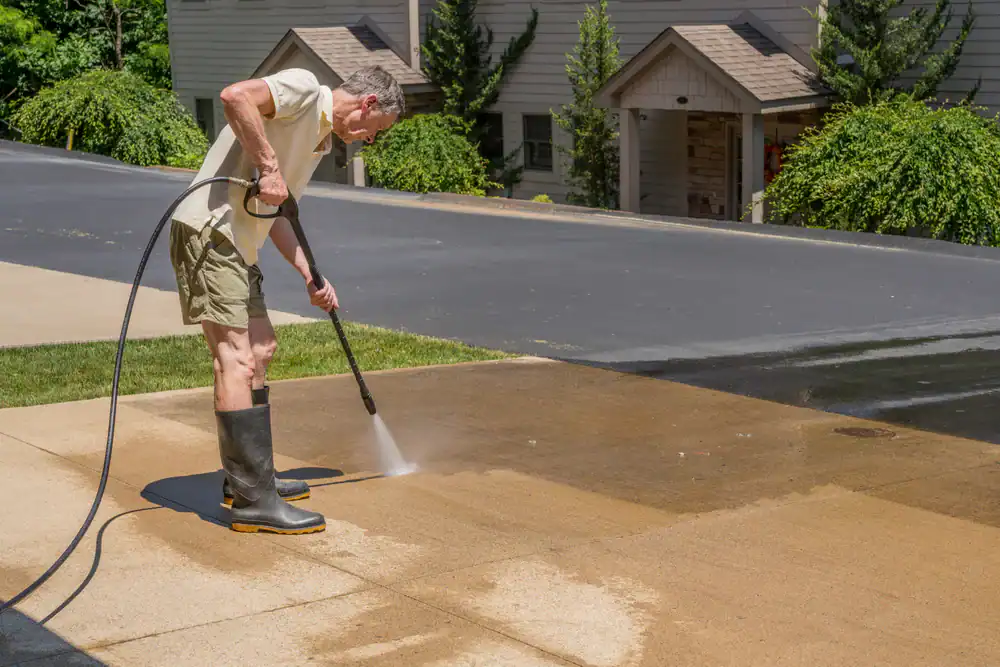
Before any water or pressure touches your driveway, we do a surface inspection. Concrete, asphalt, brick pavers, and natural stone each respond differently to pressure and chemistry and older driveways, which are common throughout Plainview’s post-war housing stock, require more careful calibration than newer installations. Getting this step wrong is how contractors cause damage. Getting it right is how we avoid it.
Once we know what we’re working with, we apply an EPA-approved pre-treatment and let it dwell. This is the step most DIY attempts skip entirely and it’s the reason professional results last longer. The pre-treatment breaks down organic growth at the root level, loosens oil and grease that have penetrated the surface, and neutralizes salt residue that has bonded to the concrete over multiple winters. We’re not just blasting the surface; we’re addressing what’s actually in it.
Then comes the pressure wash itself, using commercial-grade equipment running up to 8 GPM significantly more than any consumer or rental unit. When the cleaning is complete, we walk through the result with you before we call it done. Spring is the busiest window for driveway cleaning in Plainview, when salt damage and winter buildup are most visible and contractors book up fast so if you’re planning ahead, earlier in the season is always the better call.

Ready to get started?
Plainview driveways aren’t all the same. Plenty of homes in this area still have original mid-century concrete porous, aged, and sensitive to excessive pressure. Others have been upgraded to brick pavers, which need lower PSI settings and careful attention to joint sand that can be displaced during cleaning. Some have asphalt that requires a completely different chemical approach than concrete. What works on one surface can damage another, and that’s exactly why the pre-inspection step isn’t optional.
For concrete driveway cleaning in Plainview, we focus heavily on salt and oil removal the two most common and most damaging contaminants in this area. For brick driveways, we adjust pressure and technique to protect the paver faces and joint integrity, and we can address any masonry repairs identified during the job as part of a bundled service call. For asphalt, we use chemistry that cleans without stripping or drying out the surface.
Beyond the driveway itself, many Plainview homeowners use a single service visit to address walkways, patios, and post-winter masonry repairs or to get outdoor furniture and AC units shrink wrapped before the next cold season. If you’ve got a list of exterior items to check off, one call to us handles more than just the driveway. We’re licensed and insured in Nassau County for all of it.

For most Plainview homeowners, once a year is the practical minimum and spring is the right time to do it. After a Nassau County winter, your driveway has been through multiple freeze-thaw cycles, repeated road salt exposure, and months of wet organic debris sitting on the surface. That combination of salt residue, moisture, and biological growth doesn’t just look bad it actively degrades the surface if it’s left to sit through another warm season.
If your driveway is heavily shaded by Plainview’s mature tree canopy, you may see moss and algae return faster than a driveway in full sun, in which case a second cleaning in late summer or early fall can make a real difference going into winter. Driveways with significant oil staining from regular vehicle use also benefit from more frequent attention, since oil that isn’t removed continues to penetrate and weaken the surface over time. The condition of your specific driveway its age, surface type, and sun exposure is the real guide.
Yes, it can and it’s one of the most common complaints homeowners have after hiring the wrong contractor or using a rental unit without the right settings. Too much pressure on aging concrete etches the surface and exposes aggregate. On asphalt, it can strip the binder that holds the surface together. On brick pavers, it can blast out the joint sand that keeps the installation stable. The damage is real and, in most cases, irreversible without resurfacing or replacement.
The way to avoid it is straightforward: inspect the surface before you touch it. Plainview has a lot of older housing stock homes built in the 1950s and 1960s with driveways that have decades of wear behind them. Those surfaces need lower pressure settings and chemistry-forward cleaning rather than brute-force blasting. Our pre-service inspection determines the correct PSI, nozzle type, and detergent combination for your specific surface before any water is applied. That step is what separates a professional result from a damaged one.
Surface pressure alone won’t do it. If you blast moss off without treating it first, you’re removing what’s visible but leaving the root structure behind and it grows back, usually within a season. In Plainview, where the tree canopy creates shaded, moisture-retaining conditions on driveways throughout the year, moss has everything it needs to reestablish quickly if the underlying biology isn’t addressed.
The right approach starts with a pre-treatment application a detergent that penetrates the surface and kills the organic growth at the root level, not just the top layer. After adequate dwell time, the pressure wash removes the dead material and flushes it out of the surface pores. This process produces results that last significantly longer than a surface-only blast. It also removes the moisture-retaining layer that moss creates, which reduces the freeze-thaw damage that shaded Plainview driveways are particularly vulnerable to during winter.
It depends entirely on what chemistry we’re using. Some degreasers and cleaning agents are genuinely harmful to plants, soil, and grass and if the runoff reaches your garden beds or lawn, the damage shows up days later when it’s too late to do anything about it. This is a real concern for Plainview homeowners who have invested in mature landscaping along their driveways and walkways.
We use EPA-approved, eco-friendly detergents that are documented safe for landscaping, pets, and children. That’s a specific claim about specific chemistry not a vague “eco-friendly” label. Beyond the chemistry itself, responsible pressure washing also means managing wastewater runoff so it doesn’t enter storm drains, which is an environmental compliance issue that applies across Nassau County. If you’re asking a contractor about their detergents and they can’t give you a straight answer, that’s worth paying attention to before they start working next to your garden.
Professional driveway pressure washing on Long Island generally runs in the range of $175 to $320 for a standard residential driveway, based on square footage and surface condition. Most typical driveways fall somewhere around 500 to 600 square feet. Driveways with heavy oil or grease staining, extensive moss or algae growth, or specialty surfaces like brick pavers or natural stone may be priced higher because the process is more involved and the chemistry is more specific.
For Plainview homeowners, the more useful comparison isn’t the cleaning cost versus a competitor’s quote it’s the cleaning cost versus what you’re trying to avoid. Driveway replacement in this area runs $3,000 to $10,000 or more depending on the surface and size. Regular professional cleaning extends the life of your existing driveway by removing the salt, oil, and biological growth that accelerate surface deterioration. At the property values Plainview carries, protecting that surface with annual maintenance is a straightforward investment. We also offer a new customer discount for first-time bookings, and a discount for military and first responders.
No permit is required to have your residential driveway professionally cleaned in Plainview. However, there is a licensing requirement that matters: Nassau County requires home improvement contractors performing exterior work on residential properties to hold a valid Home Improvement Contractor license issued by the county’s Department of Consumer Affairs. This is a legal requirement, and many informal operators advertising on social media or local classified sites don’t hold it.
Why does that matter to you? If an unlicensed contractor damages your driveway, breaks a window from pressure, or gets injured on your property, you may be left holding liability that their lack of insurance and licensing creates. Nassau County homeowners can verify a contractor’s license status through the county’s online portal before anyone starts work. We’re fully licensed and insured for residential exterior work in Nassau County that’s not a differentiator we invented, it’s the baseline standard that protects your property and your investment.
Local Resources
Other Services we provide in Plainview