Professional pressure washing services and more across Long Island.
Contact Info
- Roslyn Heights, NY 11577
- Call: 516-353-8711
- Text: 516-353-8711
- 24/7 - 365 Days
Professional pressure washing services and more across Long Island.
Contact Info
Black streaks aren't just cosmetic. They're algae eating your shingles. Roof washing removes destructive organisms and can double your roof's lifespan.
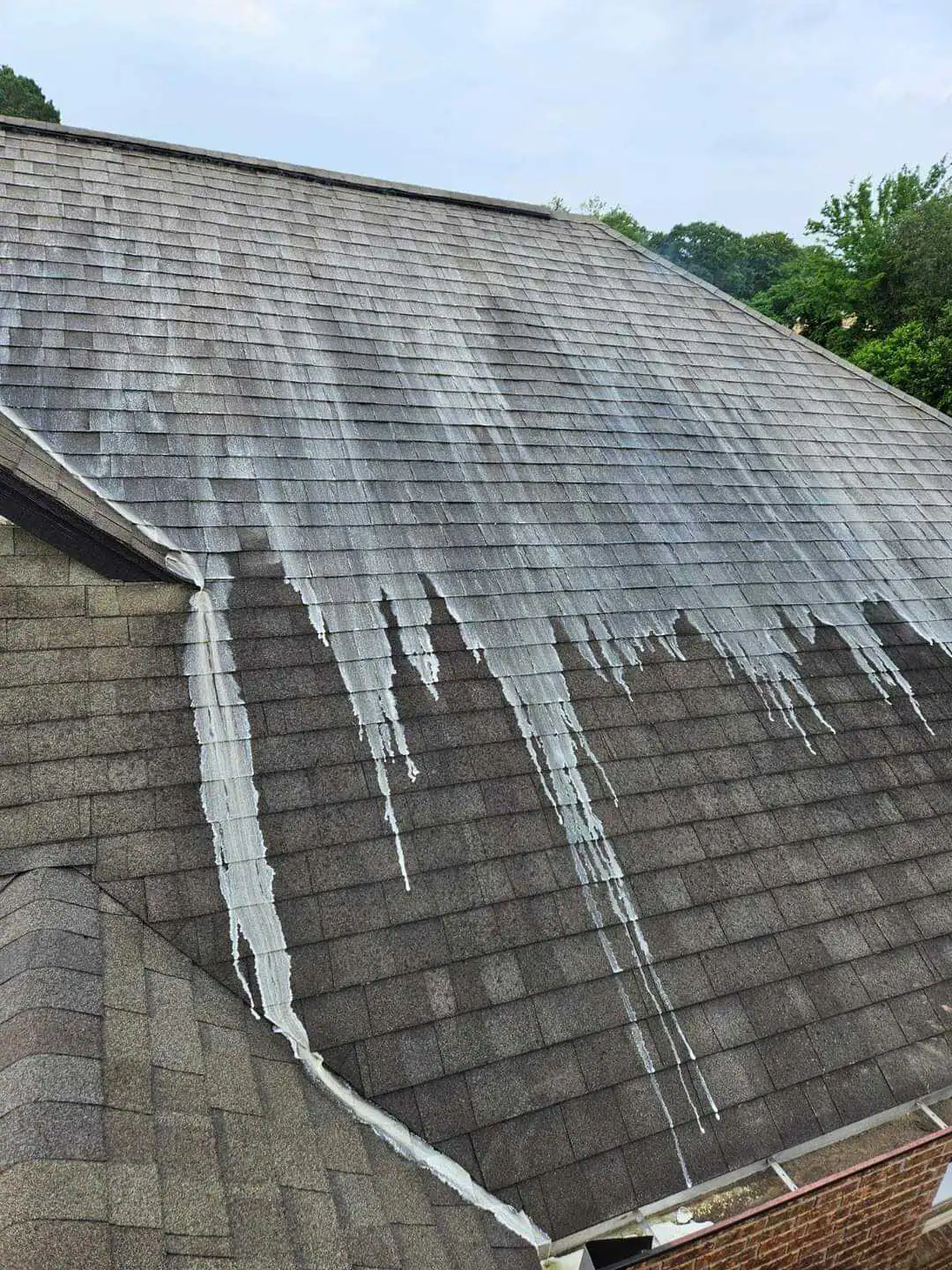
Roof washing isn’t power washing. It’s not about blasting your shingles with high pressure and hoping for the best. Professional roof cleaning uses a soft wash method—low pressure application with specialized cleaning solutions that kill organic growth at the source.
Here’s what that means for your roof’s lifespan. The black streaks you’re seeing are Gloeocapsa magma, a type of algae that literally feeds on the limestone filler in your asphalt shingles. Moss digs in with root-like structures that lift shingles and trap moisture underneath. Lichen is even more stubborn, combining algae and fungus into something that accelerates deterioration.
When these organisms take hold, they don’t just sit on the surface. They break down the protective granules on your shingles, trap moisture that leads to wood rot, and create pathways for leaks. Professional cleaning removes all of that, stops the damage, and gives your roof a chance to do its job for years longer than it would otherwise.

The damage starts small and compounds over time. Gloeocapsa magma algae doesn’t just stain your roof—it feeds on the organic materials in your shingles. Modern asphalt shingles contain limestone filler, and algae consumes it slowly, weakening the structural integrity of each shingle.
Moss is worse. It grows upward and outward, and as it expands, it lifts the edges of your shingles. Those lifted edges catch wind during storms, leading to blow-offs. More importantly, moss holds moisture against your roof surface for extended periods. That constant dampness accelerates shingle deterioration and creates the perfect environment for wood rot in your roof deck.
Then there’s the moisture trap effect. When algae and moss cover your roof, they prevent proper drying after rain or morning dew. Your roof stays wet longer, which means your shingles stay wet longer. Prolonged moisture exposure breaks down the asphalt binder, causes granule loss, and eventually leads to leaks. In Suffolk County, NY and Nassau County, NY, where humidity is high and coastal conditions create ideal growing environments, this process happens faster than in drier climates.
The organisms also spread. Algae spores are airborne and travel from roof to roof throughout neighborhoods. If you’ve noticed black streaks on multiple homes on your street, that’s not coincidence. Once algae establishes itself, it reproduces and spreads, which is why early intervention matters. The longer you wait, the more established the growth becomes, and the more damage accumulates.
There’s a right way and a wrong way to clean a roof, and the difference matters more than you might think. Pressure washing uses high-pressure water—often 1,200 PSI or more—to physically blast away dirt and growth. That sounds effective until you understand what else it’s blasting away.
Your asphalt shingles have a protective layer of granules on top. These granules shield the underlying asphalt from UV damage, make your shingles fire-resistant, and give your roof its color. High-pressure washing strips these granules off. Once they’re gone, your shingles are exposed and vulnerable. UV rays break down the asphalt faster, shingles become brittle, and you’ve just accelerated the aging process you were trying to prevent.
Pressure washing can also force water underneath shingles, especially if they’re already slightly lifted or damaged. Water driven under shingles leads to rot in the roof deck and creates leaks you won’t notice until the damage is significant. The Asphalt Roofing Manufacturers Association specifically warns against using pressure washers on roofs for these exact reasons.
Soft washing takes a different approach. It uses low-pressure application—typically under 100 PSI, about the same pressure as your garden hose—combined with specialized cleaning solutions. These solutions do the heavy lifting. They’re formulated to kill algae, moss, and lichen at the root level, breaking down the organisms chemically rather than relying on force.
The result is a thorough clean that doesn’t damage your shingles, doesn’t strip protective granules, and doesn’t void your warranty. Most major shingle manufacturers require or strongly recommend soft wash methods to maintain warranty coverage. That should tell you something about which method actually protects your investment.
In Long Island, where many roofs are exposed to salt air and humidity, soft washing also means your roof stays cleaner longer. Because the cleaning solution kills organisms at their source rather than just removing surface growth, regrowth happens more slowly. You’re not just cleaning your roof—you’re giving it a fighting chance to last.
Want live answers?
Connect with a CPR Power Washing expert for fast, friendly support.
Let’s talk numbers, because this is where the “worth it” question gets answered pretty clearly. The average cost of professional roof cleaning in Long Island ranges from $300 to $500, depending on your roof’s size and condition. The average cost of a roof replacement runs between $10,000 and $15,000.
If regular cleaning extends your roof’s life by even a few years—and research suggests it can potentially double your roof’s remaining lifespan—you’re looking at massive savings. Skip the cleaning, and you might replace your roof at year 15 instead of year 25. That’s a $10,000+ expense you could have delayed or avoided entirely with a $500 investment every few years.
Here’s the part most homeowners don’t realize: one out of every three roofs gets replaced early because the homeowner didn’t know cleaning was an option. They see black streaks, assume the roof is just old, and call a roofer for replacement quotes. Meanwhile, a professional cleaning could have removed those streaks and given that roof several more years of solid performance.

There’s another cost factor that doesn’t show up in the cleaning invoice: energy efficiency. Your roof’s color and condition directly affect how much heat your home absorbs. When your roof is covered in dark algae and moss, it absorbs significantly more heat than it should.
Clean, properly functioning roofing materials are designed to reflect a certain amount of solar radiation. That’s measured by something called the Solar Reflectance Index. When algae covers your shingles, your roof’s SRI drops dramatically. Instead of reflecting heat, your roof absorbs it, which means your attic gets hotter, which means your living space gets hotter, which means your air conditioning runs longer and harder.
Studies have shown that algae-covered roofs can absorb enough additional heat to increase cooling costs noticeably during summer months. In Nassau County, NY and Suffolk County, NY, where summers can be humid and hot, that translates to real money on your utility bills. Clean your roof, and you restore its ability to reflect heat. Your attic stays cooler, your AC doesn’t work as hard, and you save money every month.
There’s also the equipment lifespan factor. When your HVAC system has to run constantly to compensate for an overheated attic, it wears out faster. You’re looking at more frequent repairs and earlier replacement. A clean roof doesn’t just save you money on monthly bills—it extends the life of your cooling system too.
This is especially relevant in coastal Long Island areas where humidity already makes cooling systems work harder. Every bit of heat you can keep out of your attic helps. Roof washing isn’t just about the shingles—it’s about the whole system working the way it’s supposed to.
Timing matters more than most people think. The best times to schedule roof washing in Long Island are spring and fall, and there are specific reasons why these seasons work better than summer or winter.
Spring cleaning prepares your roof for the demands of summer. You’re removing winter debris, killing off any moss or algae that started growing during wet spring months, and setting your roof up to handle heat and occasional summer storms. Spring temperatures are also ideal—mild enough that cleaning solutions work effectively without evaporating too quickly, but warm enough that you’re not dealing with freezing conditions.
Fall cleaning is equally important. It removes the leaves, twigs, and debris that accumulated during summer and early autumn. More importantly, it clears organic growth before winter, when trapped moisture under moss or debris can lead to ice dam problems and accelerated freeze-thaw damage. Fall also tends to have consistent weather patterns in Long Island, making scheduling easier and ensuring the cleaning solution has time to work properly.
Summer can work, but it’s less ideal. High temperatures cause cleaning solutions to evaporate faster, reducing their effectiveness. You also risk working on a roof that’s uncomfortably hot, which can be a safety issue for professionals and can affect how well solutions penetrate organic growth.
Winter is generally not recommended unless you’re in a mild stretch. Freezing temperatures make cleaning solutions less effective, create slip hazards, and can cause solutions to freeze on contact with the roof. Most professionals won’t schedule roof cleaning when temperatures are below freezing for good reason—it’s not safe and it doesn’t work as well.
For Long Island homeowners, a good rule is to inspect your roof twice a year and clean it every one to three years, depending on how much shade your roof gets and how quickly algae returns. Homes with lots of tree cover or north-facing roof sections may need more frequent cleaning. Homes in full sun with good air circulation might stretch it to three years between cleanings.
Here’s what it comes down to. Your roof is your home’s most expensive component and its primary defense against weather. Algae, moss, and lichen are actively damaging it right now if they’re present. Professional soft wash cleaning removes that growth, stops the damage, and can extend your roof’s lifespan by years—potentially doubling its remaining life.
The cost of cleaning versus the cost of early replacement isn’t even close. You’re talking about a few hundred dollars every couple of years versus ten thousand or more for a premature roof replacement. Add in the energy savings from a roof that reflects heat properly, and the return on investment becomes even clearer.
If you’re seeing black streaks, green patches, or moss on your roof in Suffolk County or Nassau County, you’re past the prevention stage and into the intervention stage. The good news is that professional cleaning can still reverse the damage if you act before it becomes structural. We specialize in safe, effective soft wash roof cleaning that protects your shingles while removing the organisms that are shortening your roof’s life. Don’t wait until you’re shopping for replacement quotes—address it now while cleaning is still the solution.
Summary:
Share: