Professional pressure washing services and more across Long Island.
Contact Info
- Roslyn Heights, NY 11577
- Call: 516-353-8711
- Text: 516-353-8711
- 24/7 - 365 Days
Professional pressure washing services and more across Long Island.
Contact Info
Long Island winters are tough on outdoor furniture. Here's how professional shrink wrapping keeps your patio set protected from November through spring — without moving a single chair.
Every fall, Long Island homeowners face the same quiet dilemma: what do you actually do with all that outdoor furniture? The garage is already full. The tarp from last year blew off somewhere around January. And the patio set you spent real money on is just sitting there, exposed to whatever the season decides to throw at it.
Professional shrink wrapping solves that problem in a way that’s cleaner, more reliable, and more practical than most people expect. We’ve installed hundreds of wraps across Suffolk County and Nassau County, and the results speak for themselves. This page covers how it works, what it protects against, and why the approach matters — especially here on Long Island, where winters aren’t just cold, they’re coastal.
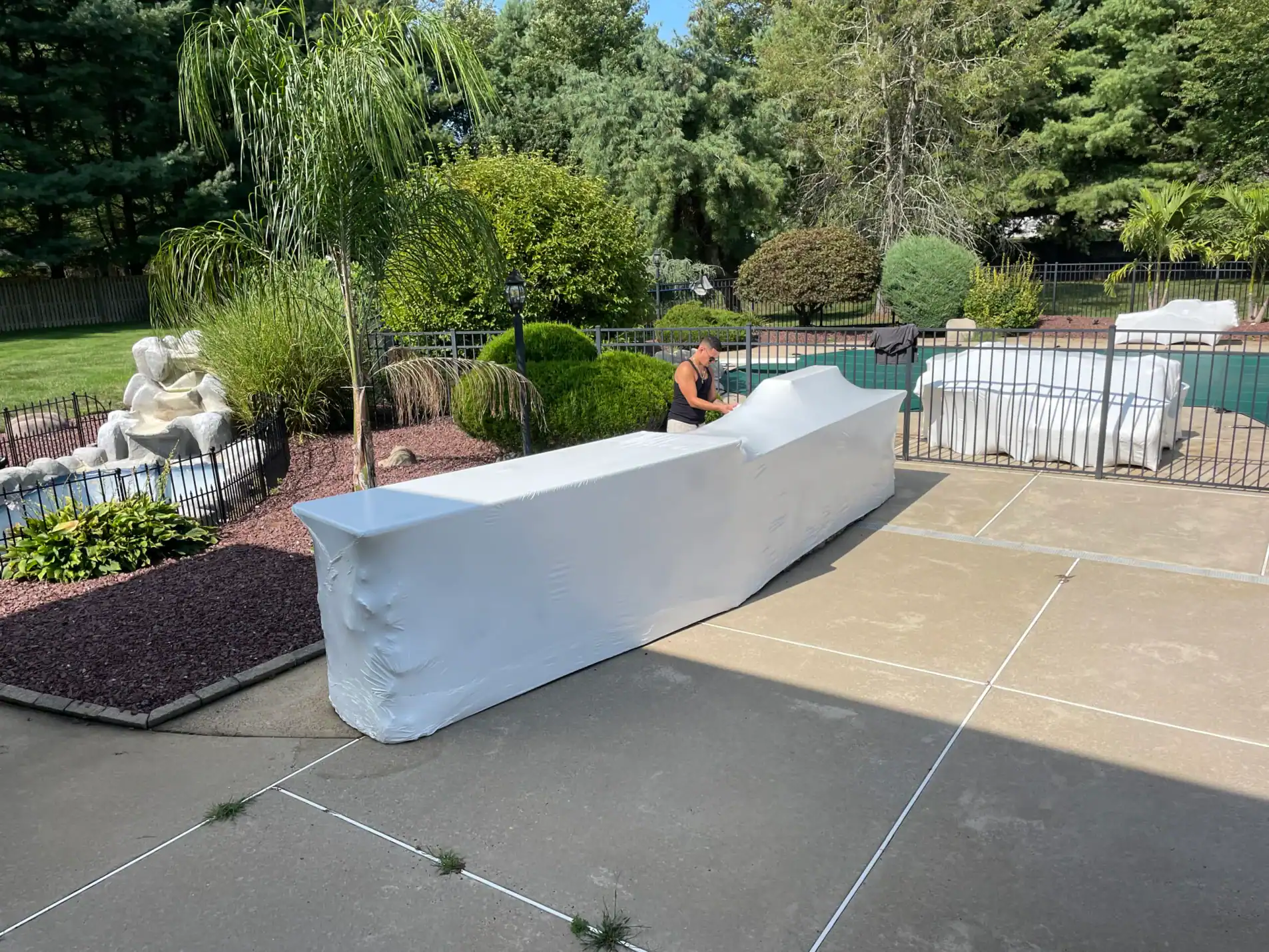
Shrink wrapping for outdoor furniture is exactly what it sounds like — your patio set, dining chairs, lounge cushions, or AC unit gets wrapped in a thick polyethylene film, heat-sealed on-site, and left fully protected until spring. The material shrinks tight around whatever it’s covering, leaving no loose edges, no flapping plastic, and no gaps for water or pests to sneak through.
The technology originally came from the marine industry, where it’s been used for decades to protect boats during winter storage. The same 7 Mil thick, UV-resistant film that keeps a boat’s hull in good condition through a nor’easter works just as well around a teak dining set or a metal sectional frame. It’s not a gimmick — it’s a proven material applied with professional heat gun equipment, done right at your home, with everything staying exactly where it sits.
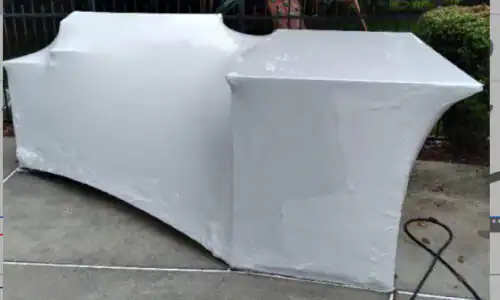
A tarp seems like a reasonable solution until you’ve watched one blow across your backyard in a February nor’easter. Long Island sits directly in the path of some of the most powerful coastal storms on the East Coast. Those storms don’t just bring snow — they bring sustained winds and gusts that can hit 50 to 70 miles per hour or more. A tarp held down by bungee cords or rope ties simply isn’t built for that.
Even in a mild winter, tarps create problems that most homeowners don’t notice until spring. Water pools on top of a flat tarp and eventually freezes, adding weight and pressure to whatever’s underneath. When it thaws, that water seeps through any gap in the cover and sits against the furniture surface. Over a full winter season — with Long Island temperatures cycling above and below freezing repeatedly — that moisture works its way into metal joints, wicker weave, and cushion fill, accelerating rust, mold, and material breakdown faster than most people realize.
There’s also the friction issue. Tarps move in the wind, even slightly, and that constant low-level movement against metal frames and chair legs leaves scratches and surface abrasion. Tie-down straps and grommets can mark furniture finishes over months of contact. It’s not dramatic damage, but it’s cumulative — and it adds up over a few seasons.
Shrink wrap doesn’t move. Once it’s heat-sealed, it’s drum-tight and stays that way. There are no loose edges catching wind, no pooling surfaces, and no contact points rubbing against your furniture all winter. That’s the fundamental difference — and it’s why homeowners across Suffolk County and Nassau County who’ve tried both rarely go back to tarps.
This is the question we hear most often, and it’s a fair one. The concern makes sense — wrap something in plastic and moisture has nowhere to go, right? That’s true of a bad shrink wrap job. It’s not true of a professional one.
Every wrap we install includes air vents. These aren’t an afterthought — they’re a required part of the process. The vents allow air to circulate inside the wrap while keeping rain, snow, and debris out. That airflow prevents the condensation buildup that leads to mold. It’s the same principle used in professional boat wrapping, where the stakes for getting it wrong are even higher.
The mold problem people have heard about almost always traces back to one of two things: consumer-grade plastic sheeting with no ventilation, or a DIY wrap job where vents were skipped to save time. When vents are properly installed, the inside of the wrap stays dry and breathable. When they’re not, you’re essentially sealing your furniture inside a humid bag for four months.
If you’ve been hesitant about shrink wrapping in Brookville because of mold concerns, the answer is to ask your provider specifically how they handle ventilation. A properly vented, professionally installed wrap won’t trap moisture. It’ll keep your furniture in the same condition it went in, ready to use the moment you pull it out in spring.
Want live answers?
Connect with a CPR Power Washing expert for fast, friendly support.
The process is simpler than most people expect, and it doesn’t require you to move anything or clear out garage space. We come to your home, assess what needs to be wrapped, and handle everything on-site. Furniture gets stacked and bundled where it already sits — with protective material placed between pieces to prevent scratching — and then wrapped using 7 Mil polyethylene film applied with a heat gun.
Once the film is in place, it gets shrunk tight, seamed, and sealed at the perimeter using shrink tape and strapping. Vents are installed before the job is finished. The whole thing is secure, clean, and ready for whatever the winter brings. In spring, removal is straightforward — the wrap comes off cleanly, with no residue and no damage to the furniture underneath.
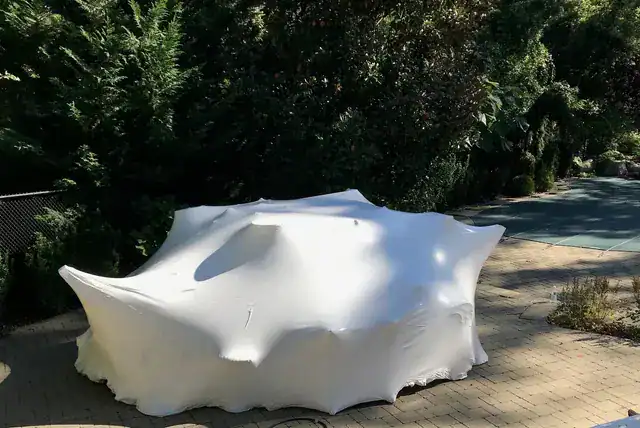
Most homeowners start thinking about wrapping their patio dining set or sectional, which makes sense — those are usually the biggest investments sitting outside. But the same process works well for a wider range of items than most people realize.
Outdoor dining sets, lounge chairs, chaise sets, wicker furniture, teak benches, fire pits, outdoor sectionals, and patio umbrellas are all common candidates. Outdoor kitchens and built-in grill stations can be wrapped to protect stainless steel components from salt air corrosion and freeze-thaw damage over the winter months. Playground sets are another one — the hardware, wood, and plastic components on a swingset take a beating over a Long Island winter, and wrapping extends the life of those materials significantly.
Central air condenser units are also worth wrapping once the cooling season ends. These units are built for outdoor use, but they’re not designed to sit in pooled snowmelt or absorb months of salt air without any protection. A properly installed wrap keeps the coils, fan motor, and housing in better condition through the off-season — which means fewer repair calls in May when you turn the system back on.
We focus on residential applications for homeowners in Suffolk County and Nassau County. That focus keeps the work consistent and the results predictable.
Long Island’s environment is harder on outdoor furniture than most people account for when they’re buying it. The combination of coastal salt air, repeated freeze-thaw cycles, and the occasional nor’easter creates conditions that accelerate damage faster than a standard Midwest or inland winter would.
Salt air is the one that catches people off guard. If you live anywhere near the Long Island Sound — in communities like Roslyn, Manhasset, Port Washington, Oyster Bay, Huntington, or Northport, we also shrink wrap in Jericho, your outdoor furniture is exposed to corrosive salt particles year-round, not just in winter. That salt deposits on metal frames, fasteners, and hardware, and when moisture is added to the equation, rust develops quickly. A sealed wrap cuts off that exposure entirely during the months when the furniture isn’t in use.
The freeze-thaw cycle is the other major factor. Long Island’s coastal position means temperatures fluctuate across the freezing point repeatedly throughout the winter rather than staying consistently cold. January averages a high of around 37°F and a low near 27°F — which means most nights dip below freezing and most days climb back above it. Every time that happens, any water sitting in a furniture joint, cushion seam, or wicker weave expands as it freezes and contracts as it thaws. Over a full season, that repeated stress cracks wood, warps metal, and accelerates the breakdown of fabric and fill.
There’s also the practical reality of storage space. Homes throughout Suffolk County and Nassau County were largely built in the 1950s and 1960s, and most garages were designed for one car and a lawn mower — not a six-piece dining set plus a sectional. In communities like Garden City, Hicksville, Bellmore, and Wantagh, the garage simply isn’t an option for most homeowners. On-site wrapping isn’t just convenient in that context — it’s often the only realistic choice.
Bundling shrink wrapping in Glen Head with a fall power washing visit makes the whole process even more efficient. We can clean your patio, driveway, and exterior surfaces, flag any masonry issues worth addressing before the cold arrives, and wrap your furniture all in one visit. One call, one crew, one day — and your outdoor space is fully prepared for winter.
If your outdoor furniture represents a real investment — and for most homeowners in Suffolk County and Nassau County, it does — then protecting it through a Long Island winter isn’t optional, it’s just smart maintenance. The cost of one professional wrap is a fraction of what it costs to replace a quality patio set that’s been left exposed to salt air, freeze-thaw cycles, and a nor’easter or two.
The process is straightforward, the results hold up, and you don’t have to move a single piece of furniture to make it happen. Everything stays where it is, wrapped tight, vented properly, and ready to uncover when the weather turns back in your favor.
If you’re in Suffolk County or Nassau County and want to get your outdoor furniture and equipment protected before winter sets in, reach out to us. We’ll take a look at what you’ve got, give you an honest assessment, and handle everything from there.
Summary:
Share: