Professional pressure washing services and more across Long Island.
Contact Info
- Roslyn Heights, NY 11577
- Call: 516-353-8711
- Text: 516-353-8711
- 24/7 - 365 Days
Professional pressure washing services and more across Long Island.
Contact Info
Long Island winters are harder on outdoor furniture than most people realize. Here's what professional shrink wrapping actually does — and why it's worth it.
You spent real money on that patio set. The sectional, the dining table, the lounge chairs — it adds up fast. And every October, the same thought crosses your mind: I should do something about all of this before it gets cold.
Most people don’t. Or they throw a tarp over it, hope for the best, and come back in April to find cushions that smell like a basement and chair legs that are starting to rust. That’s just what Long Island winters do to outdoor furniture that isn’t properly protected — especially here in Nassau and Suffolk County, where the combination of salt air and freeze-thaw cycles accelerates damage.
This page covers what professional shrink wrapping actually involves, what it protects against, and why it’s a smarter call than the alternatives.
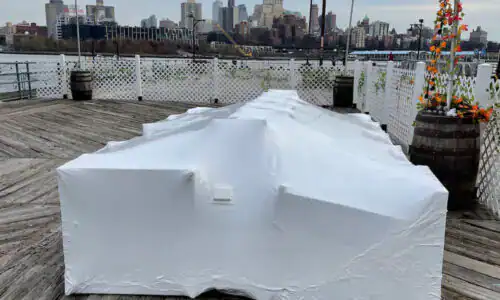
Shrink wrapping is exactly what it sounds like — your outdoor furniture, patio sets, or wall AC units are wrapped in a thick polyethylene film, then sealed with a heat gun that causes the material to shrink tight around the bundle. The result is a firm, weather-resistant shell that conforms to the shape of whatever is inside.
It’s not a loose cover that catches wind or pools water on top. It’s a sealed wrap that stays put through snow, rain, and the kind of February wind gusts that come straight off the Long Island Sound. The material we use for professional residential jobs is marine-grade — the same stuff used to wrap boats over the winter — because it’s built to handle exactly this kind of exposure.
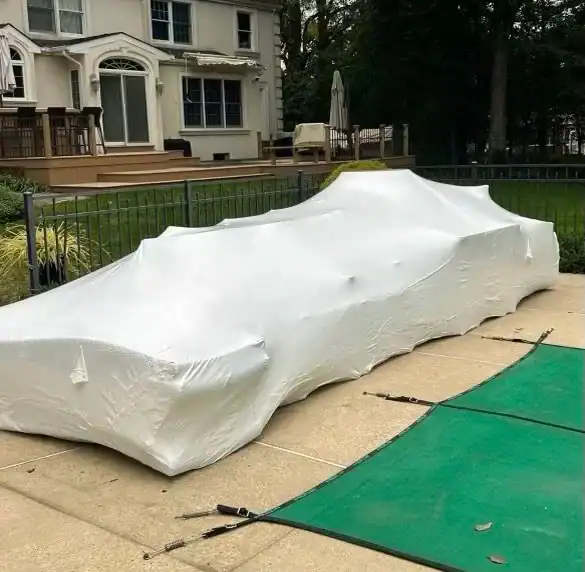
When we show up to do a shrink wrap job in Nassau or Suffolk County, the process is straightforward but it requires the right equipment and technique to do it correctly. First, the furniture gets stacked and organized — cushions, ottomans, chairs, and the table frame grouped together in a way that minimizes wasted space and creates a stable bundle. Nothing gets hauled away. Everything stays right where it is in your backyard or on your patio.
Once the bundle is set, we wrap it in marine-grade polyethylene film — typically 7-mil thickness, which is heavy enough to handle snow loads, resist tearing in high winds, and block UV exposure that fades fabric and finishes over time. The film goes around the entire bundle, top to bottom, with no gaps at the base or corners where moisture and pests could work their way in.
Then comes the heat gun. This is where technique matters. Too much heat in one spot and the wrap burns. Too little and it doesn’t seal properly. Done right, the material shrinks down uniformly, pulling tight against the bundle and creating a firm, consistent shell. After the wrap is sealed, we cut ventilation ports into the material. This step gets skipped by a lot of informal operators, and it’s a mistake — without vents, you’re trapping humid air inside the wrap, which creates exactly the mold and mildew conditions you were trying to avoid in the first place.
The whole process is done on-site. No scheduling a separate pickup, no renting a truck to move furniture into storage, no trying to fit a sectional into a two-car garage that’s already full. When we leave, your furniture is wrapped, protected, and ready for whatever the winter brings.
This is the most common question we hear, and it’s a fair one. Tarps are cheap and easy to find. Patio furniture covers are sold at every home improvement store on Long Island. So why pay for professional shrink wrapping in Plainview?
Long Island winters aren’t mild. From November through March, you’re dealing with repeated freeze-thaw cycles — temperatures above freezing during the day, below freezing at night, over and over again. Every time that happens, any moisture that’s worked its way into wood grain, cushion fill, or metal joints expands as it freezes and contracts as it thaws. That cycle is what splits wood, corrodes metal, and saturates cushions with the kind of mold that doesn’t come out.
Tarps make this worse, not better. They shift in the wind, which means gaps open up at the edges. Water pools on top and eventually finds its way underneath. The humid, enclosed environment under a tarp is actually ideal for mold growth. And if you’ve ever come out in April to find your tarp blown halfway across the yard, you know they don’t exactly hold up.
Our shrink wrap seals completely. It conforms to the shape of the bundle, so there are no loose edges to catch wind. It doesn’t pool water — the tight surface sheds it. And because it wraps completely around the furniture, there’s no gap at the base where rodents or other pests can get in and make themselves comfortable over the winter. That last point is more relevant than most people expect — it’s not unusual to unwrap a patio set in the spring and find evidence that something was living in there all winter.
DIY shrink wrap kits do exist, but they come with a real learning curve. Applying the material evenly, using the heat gun correctly, and knowing where to place ventilation ports are all things that take practice. Improper application often leads to tears, uneven sealing, or moisture trapped underneath — which defeats the purpose entirely.
Want live answers?
Connect with a CPR Power Washing expert for fast, friendly support.
This isn’t a service that makes equal sense everywhere. Long Island’s specific combination of climate conditions and housing stock creates a stronger case for professional shrink wrapping Searingtown than you’d find in a drier inland market.
The salt air is the part that most people underestimate. If you’re in Port Washington, Cold Spring Harbor, Oyster Bay, or anywhere else along the North Shore, your outdoor furniture is getting hit with salt air off the Long Island Sound for most of the year. Salt accelerates corrosion on metal frames, degrades fabric, and works into finishes in ways that aren’t always visible until the damage is already done. Add winter moisture and freeze-thaw cycles on top of that, and furniture that might last ten years in a different climate might need replacing in five.
Even if you’re further inland in Nassau County communities like Garden City or New Hyde Park, you’re still dealing with the same freeze-thaw damage and moisture issues that make proper protection essential. The difference between a patio set that lasts and one that deteriorates quickly comes down to how well it’s sealed during the winter months.
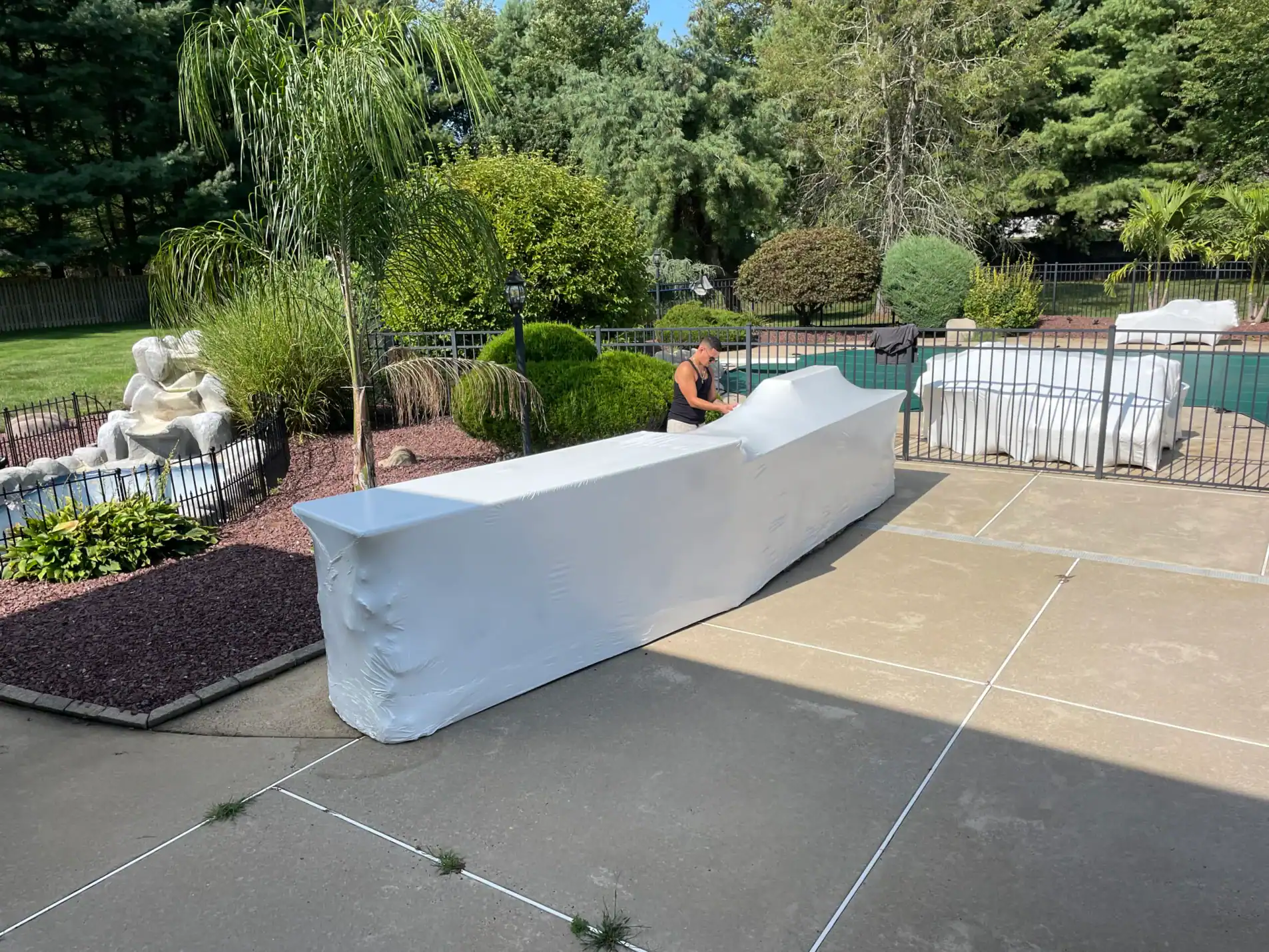
Yes — and this is one of the most overlooked applications of the service, especially in Nassau County. A significant portion of the housing stock in communities like Levittown, Garden City, New Hyde Park, and Mineola was built in the 1950s through 1970s, and those homes rely heavily on wall and window AC units. When winter comes, those units become a direct path for cold air to enter your home.
A wall AC unit that isn’t sealed or covered is essentially a gap in your insulation. Cold air pushes through the vents, around the edges of the unit, and into your living space all winter long. That drives up your heating bill and makes certain rooms harder to keep warm. Our shrink wrapping seals that gap — it blocks drafts, prevents heat from escaping, and keeps the unit itself protected from moisture and debris during the months it isn’t running.
It’s a simple addition to a fall shrink wrap appointment and one that pays for itself quickly in reduced energy loss. If you’re already having your patio furniture wrapped, adding the AC unit to the same visit takes minimal extra time and eliminates a separate task you’d otherwise have to deal with on your own.
For homeowners on the East End — particularly those with seasonal properties in the Hamptons or Northport who won’t be at the house all winter — this matters even more. When no one is around to check on things, having everything properly sealed before you leave gives you real peace of mind. A wrap job done right in November shouldn’t need any attention until you’re ready to open things back up in the spring.
Professional shrink wrapping for a full patio set — a dining table, several chairs, a sectional, and a few accessories — typically runs in the range of $300 to $600, depending on the volume of items and the complexity of the job. That’s the going rate for a professional, on-site service using proper marine-grade materials with ventilation included.
That number sounds more reasonable when you put it next to the cost of replacing what you’re protecting. A quality outdoor sectional in Nassau or Suffolk County can run $2,000 to $5,000 on its own. A full outdoor dining set with chairs is often in the same range. A complete outdoor kitchen setup can easily reach $10,000 or more. Shrink wrapping is essentially an insurance policy on an investment you’ve already made — and a relatively inexpensive one at that.
The alternative isn’t really free, either. Cheap patio covers wear out and need replacing. DIY shrink wrap kits require purchasing materials and a heat gun, and if the application isn’t right, you’ve spent money and still don’t have adequate protection. And if furniture gets damaged over the winter — cracked wood, corroded frames, ruined cushions — you’re looking at repair or replacement costs that dwarf what professional wrapping would have cost.
We’re a licensed and insured operation, which matters when someone is working around your property and your outdoor furniture. A lot of informal operators in the shrink wrapping space carry no insurance at all, which means if something goes wrong — a piece of furniture gets damaged during the process, or there’s any kind of incident on your property — there’s no coverage. That’s a risk that’s easy to avoid by choosing a company that’s properly set up. Every job we do ends with a walkthrough so you can see the finished work before we leave.
Long Island winters are predictable in one way: they will find whatever you haven’t protected. The freeze-thaw cycles, the salt air, the snow — none of it is unusual, and none of it is going anywhere. What changes is whether your outdoor furniture, patio set, and AC units are ready for it.
Professional shrink wrapping is one of those services that’s easy to put off until it’s too late in the season. The window for getting it done right — before the first hard freeze — is shorter than most people expect. If you’re in Nassau County, Suffolk County, or anywhere across Long Island and you want a straight answer on what it would take to get your outdoor space properly protected this winter, reach out to CPR Power Washing. We’ll give you an honest estimate and get it scheduled before the weather makes the decision for you.
Summary:
Share: